
ICH promises to be a space for engaging
with peace and compassion, and with the questions
of power, law, and inequality that shape justice
in everyday life.
ICH promises to be a space for engaging with peace and compassion, and with the questions of power, law, and inequality that shape justice in everyday life.
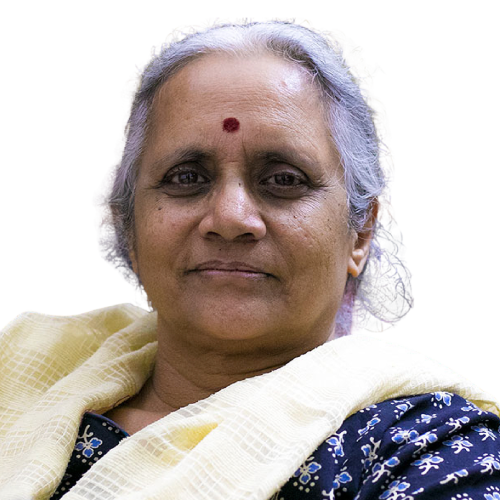
Usha Ramanathan
Human Rights Scholar
Who is Usha
Usha Ramanathan is a legal scholar and public intellectual whose work sits at the intersection of law, poverty, rights, and institutional power. Her scholarship interrogates the nature of law and its lived consequences, spanning issues such as the Bhopal Gas Disaster, mass displacement, eminent domain, manual scavenging, civil liberties, the death penalty, criminal law, custodial institutions, environmental justice, and the judicial process. Over the years, she has written and spoken extensively on how legal systems shape and often constrain the human conditions of freedom and liberty.
A significant strand of her work has focused on the Indian national identity project, which she has tracked, critiqued, and engaged with through sustained research, public writing, and debate. More recently, her work has expanded to examine the implications of technology on rights, dignity, and democratic accountability, consistently grounding abstract legal questions in their social and ethical impact.
Usha Ramanathan has served as visiting faculty at several leading institutions, including Azim Premji University (Bengaluru), NALSAR and Mahindra University (Hyderabad), National Law University Delhi, and the Institute of Law at Nirma University (Ahmedabad). She has been a member of multiple high-level expert and government committees, including the Expert Group on Privacy constituted by the Planning Commission of India (2011–12), the Department of Biotechnology committee reviewing the Draft Human DNA Profiling Bill (2013–14), and the Prime Minister’s Office committee on the socio-economic status of tribal communities (2013–14). She has also contributed to several committees examining and revising vagrancy laws.
In recognition of her sustained commitment to human rights and civil liberties, she was awarded Access Now’s Human Rights Heroes Award in 2019.
Area of Expertise:
Jurisprudence, law and poverty, civil liberties and human rights, environmental justice, state accountability, and the intersections of technology, privacy, and democratic rights.